
How Do You Decide If You Need a Retail Execution App in 2026?

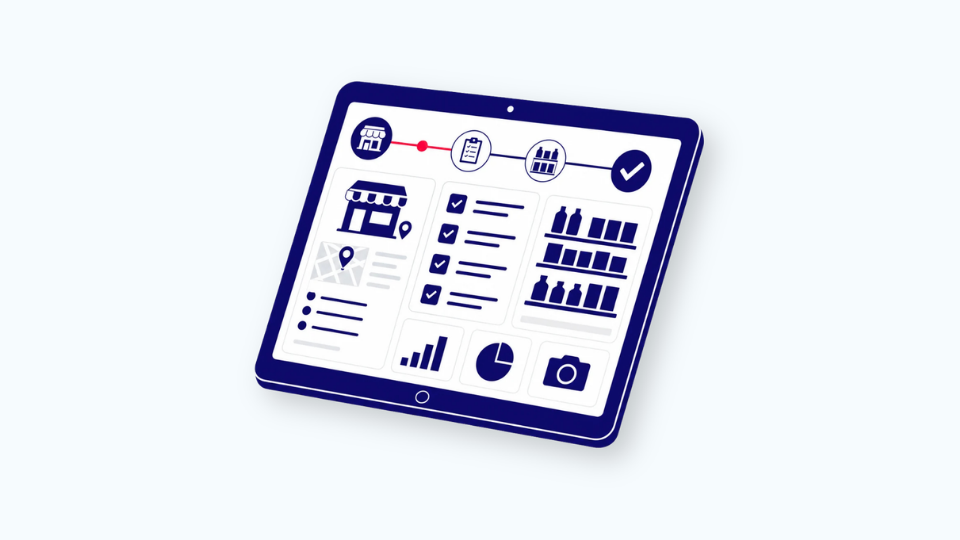
Your field reps visit stores every day. They check shelves, talk to managers, spot competitor activity, and identify reorder opportunities.
The question isn't whether this generates valuable information. It does.
The question is whether that information reaches the people who need it, in a format they can use, fast enough to act on it.
For some organizations, phone photos and weekly reports work fine. For others, the gap between what reps see and what the business knows costs real money.
This article helps you figure out which situation you're in.
ON THIS PAGE
- What Store Visits Actually Produce
- Signs You Might Have a Data Gap
- Your Options for Capturing Store Visit Data
- Questions to Guide Your Decision
- When an Integrated Approach Makes Sense
- How Elixir's Retail Execution App Works
- Getting Started
- Assessing Your Situation
What Store Visits Produce
Every store visit generates potential business value in three categories:
Compliance data: Are your products placed where your trade agreements specify? Are promotional displays set up correctly? Are competitors encroaching on your shelf space?
Order opportunities: Is stock running low on fast-moving products? Does the store manager want to reorder? Are there gaps you could fill before a competitor does?
Market intelligence: What are competitors doing? What promotions are they running? What feedback do store managers have about your products vs. alternatives?
The challenge: this information is perishable. A reorder opportunity today is gone by next week. A compliance issue spotted in January but reported in March is three months of lost shelf space.
Signs You Might Have a Data Gap
Not every organization requires a specialized retail execution platform. However, if your current workflow experiences the following friction points, you likely have a data gap that is best solved by unifying your commercial operations.
1. Fragmented Commercial Intelligence
The biggest "sign" of a gap is data siloed across different departments. A true competitive advantage comes from having all commercial data in one platform. When sales figures, marketing efforts, customer service history, and real-time field data are disconnected, you lose the "big picture." We leverage HubSpot’s USP to bring these four pillars into a single source of truth, ensuring the field knows what sales is doing, and marketing sees what the field is discovering.
2. Reactive Compliance Visibility
If you discover shelf-placement discrepancies during quarterly reviews, the window for correction has closed. Without a unified platform, trade spend is a "blind" investment. By integrating field data with your central CRM, visibility moves from historical to instantaneous.
3. Unstructured Field Intelligence
Field reps are your eyes and ears, but competitor shifts often stay locked in isolated conversations. A data gap exists when this intelligence lacks a structured pathway to leadership. Within a unified ecosystem, field observations automatically inform your marketing and product strategies.
4. Administrative Reporting Lag & Visual Chaos
If managers spend time chasing end-of-week reports or scrolling through camera rolls to find site photos, your data is a bottleneck. In a modular, single-platform setup, documentation and reporting happen in real-time, allowing leadership to act on data rather than just compile it.
The Verdict
If these scenarios resonate, your organization is likely suffering from "platform sprawl." We specialize in closing these gaps by consolidating your sales, field, marketing, and service data into one seamless HubSpot environment.
Your Options for Capturing Store Visit Data
Option 1: Manual processes with basic tools
How it works: Reps use phone cameras for photos, notes apps or paper for observations, and submit reports via email or spreadsheet at the end of the day or week.
Works well when:
- You have a small field team (under 10 reps)
- Compliance requirements are simple
- Order capture happens through a separate process or by taking paper notes
- You don't need to aggregate data across many stores
- Reps are disciplined about documentation
Limitations:
- Data quality depends entirely on individual reps
- Photos are unorganized and hard to retrieve
- Intelligence stays fragmented
- No real-time visibility into field activity
- Difficult to spot patterns across stores or regions
Cost: Low direct cost, but hidden costs in lost orders and invisible compliance issues.
Option 2: CRM mobile app with supplementary tools
How it works: Reps use your CRM's mobile app (HubSpot, Salesforce, etc.) for account access and activity logging, combined with separate tools for photos or notes.
Works well when:
- You primarily need account reference during visits
- Visit documentation is secondary to relationship management
- Your team already uses the CRM consistently
- Compliance tracking isn't a priority
Limitations:
- CRM mobile apps are built for account management, not high-volume store execution
- No structured compliance capture
- No order entry workflow
- Photos still require separate organization
- Multiple apps mean fragmented data
- No stock orders are possible
Cost: Included with your CRM subscription, but doesn't solve the core retail execution problem.
Option 3: Standalone retail execution app
How it works: A dedicated app for field visits with features like visit scheduling, photo capture, checklists, and basic reporting.
Works well when:
- Your compliance requirements match standard templates
- You don't need real-time inventory for order capture
- Basic visit documentation meets your needs
- Your workflows fit the app's structure
Limitations:
- Limited integration depth with your CRM and ERP
- Fixed workflows that may not match your specific processes
- Photo organization varies by vendor
- Order capture may not sync to the backend
- Customization depends on vendor roadmap
Cost: Typically per-user monthly fees. Implementation is faster but flexibility is limited.
Option 4: Integrated retail execution with CRM and ERP connection
How it works: A retail execution app built to connect with your CRM (for customer data, activity sync, and reporting) and your ERP or order management system (for inventory visibility and order capture). We would then send all data to your CRM, and then send a subset of that data, like sales orders, to the ERP system.
Works well when:
- There is potential for an on-site order capture with real-time inventory
- Compliance requirements are specific to your industry or trade agreements
- You want field data flowing directly into your CRM
- Intelligence aggregation across stores matters for strategic decisions
Limitations:
- Higher initial investment than standalone apps
- Implementation takes longer (weeks instead of days)
- Requires commitment to process alignment
Cost: Higher upfront, but addresses the full problem instead of part of it.
Questions to Guide Your Decision
How complex are your compliance requirements?
If you use standard planograms and basic shelf checks, a standalone app with templates may work. If you have specific trade agreements, custom compliance scoring, or industry-specific requirements (temperature tracking, regulatory documentation), you'll need configurability.
Do you need order capture in the field?
If orders flow through a separate process and reps just flag opportunities, basic tools can work. If you want reps creating orders on-site with real-time inventory visibility and manager approval, you need ERP integration.
How important is intelligence aggregation?
If field observations are nice-to-have background information, structured capture may not be worth the investment. If competitive intelligence and store feedback should inform marketing, product, and sales strategy, you need data flowing into systems where it can be analyzed.
What's your team size?
Smaller teams can sometimes make manual processes work through discipline and communication. Larger teams need systems that enforce consistency and aggregate data automatically.
How much do you need to customize over time?
If your processes are stable, a fixed-workflow app may be fine. If you expect your compliance standards, visit types, or data requirements to evolve, you need a solution you can modify.
When an Integrated Approach Makes Sense
Based on our implementations for food and beverage companies and consumer goods manufacturers, integrated retail execution delivers the most value when:
- Trade spend is significant and you need to verify you're getting what you pay for
- Order capture timing matters and delays cost you revenue
- Field intelligence is strategic and should inform decisions beyond the field team
- Compliance is specific to your trade agreements or industry requirements
- You already use HubSpot and want field data in your CRM without manual syncing
If these conditions apply, the investment in integration pays back through captured orders, visible compliance, and usable intelligence.
If they don't apply, a simpler solution may serve you well.
How Elixir's Retail Execution App Works
For organizations that need integrated retail execution, we built an app that connects field reps to both HubSpot and your business systems.
Speed-first design
Every screen optimized for fast data entry. Large touch targets. Minimal taps. Pre-loaded account data. High-volume visit schedules require tools that save time, not add steps.
Structured visit workflows
Reps follow guided workflows based on visit purpose: merchandising checks, promotional audits, order capture, competitive intelligence. Consistent data capture across your entire field team.
Automatic photo organization
Photos tag by account, visit date, and category. Your compliance team retrieves images by region, chain, and time period without scrolling through camera rolls.
Offline operation
Full functionality without connectivity. Reps access account data, capture visits, create orders. Everything syncs when connectivity returns.
CRM integration
Visit records, compliance scores, photos, orders, and market intelligence flow directly into HubSpot. Real-time visibility without chasing reps for reports.
Order capture with system connection
When connected to your CRM or order management system, reps see inventory and create orders on-site. Store managers approve digitally. Orders reach fulfillment immediately.
Industry configurations
Food and beverage (temperature compliance, freshness tracking, rotation audits), consumer packaged goods (planogram scoring, promotional display verification), pharmaceutical (regulatory documentation, expiration tracking).
Getting Started
The Retail Execution App is available on the HubSpot marketplace with standard functionality for immediate deployment.
If you need customization, our development team built the app internally. We modify workflows, screens, and integrations to match your operations. No feature request queues.
Deployment options
|
Approach |
Timeline |
Investment |
|
Standard deployment |
3-4 days |
€60 per user per month plus setup |
|
Industry-specific configuration |
Varies |
Custom quote |
Assessing Your Situation
Before choosing any solution, answer these questions:
- What's the actual cost of your current data gap? Can you estimate lost orders, invisible compliance issues, or unused intelligence?
- What's the minimum you need? Sometimes a simpler solution is enough.
- What's your CRM and ERP situation? Integration complexity affects which options are realistic.
- How will you measure success? Define what "working" looks like before you invest.
If you'd like help thinking through these questions, we're happy to have that conversation, whether or not Elixir's solution is the right fit.
Want to assess your retail execution needs?
Fill in our contact form to schedule a conversation. We'll discuss your situation and help you evaluate your options honestly.

