
Salesforce CPQ End-of-sales: Complete Guide for Mid-Market Companies

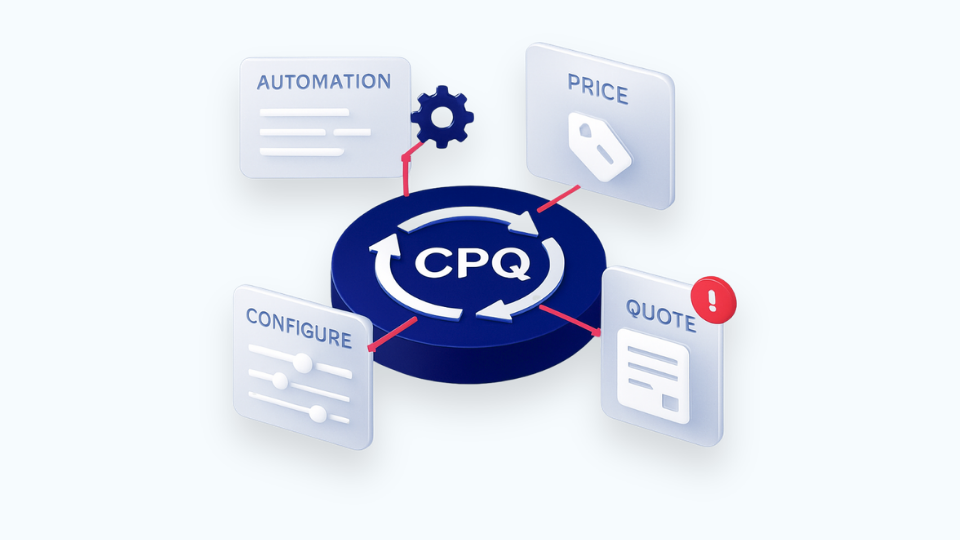
Salesforce moved CPQ to End-of-Sale in March 2025. Your system still runs. Support continues. New product investment now goes to Revenue Cloud. You have a 12 to 18 month window to evaluate your options before migration timelines tighten. This guide explains what End-of-Sale means, your three paths, real costs, and how to decide without rushing. For some companies the right path is Revenue Cloud. For others it is an independent CPQ. This guide helps you tell which.
ON THIS PAGE
What does Salesforce CPQ End-of-Sale mean?
End-of-Sale means Salesforce stopped selling CPQ to new customers in March 2025. Existing customers keep their licenses. Technical support continues. The product receives no new features. Salesforce now points new buyers to Revenue Cloud Advanced.
End-of-Sale is not End-of-Life. Salesforce has not announced a formal End-of-Life date. Most of the market treats the End-of-Sale signal as the start of a countdown, because R&D and support resources are shifting toward Revenue Cloud.
A practical planning view:
- 2025 to 2026: Upgrade pressure rises. Support quality drifts as engineering moves to Revenue Cloud.
- 2027 to 2028: A formal End-of-Life notice is widely expected. (Projection, not an announced date.)
- 2029 to 2030: Support likely ends and migration becomes mandatory. (Projection.)
Reading the timeline this way protects one thing you care about most: control. You decide when and how you move, on your own schedule.
Why does the timing matter for your business?
The cost of waiting is not the license fee. It is lost leverage.
Start your evaluation in 2026 and you finish migration before the expected End-of-Life window. You negotiate from a position of choice. Implementation partners have capacity. You have time to test properly.
Wait until 2028 and the picture inverts. You migrate under deadline pressure. Your negotiating position weakens. Partner availability shrinks as every CPQ customer moves at once. Compressed timelines raise the risk of a failed implementation.
For a CFO, this is a budgeting decision you want to make on your terms, in a planned fiscal year, not as an emergency line item in 2029.
What are your three migration options?
Option 1: Migrate to Salesforce Revenue Cloud
You rebuild CPQ on Salesforce's next-generation platform. This is a full reimplementation on native architecture, not an upgrade.
What you gain: A unified revenue lifecycle across quote, contract, billing, and revenue recognition. AI-assisted quoting through Agentforce. Tight integration if you run multiple Salesforce clouds.
What it costs you: Higher licensing and a long rebuild. More on the numbers below.
Who it fits: Companies using Service Cloud and Marketing Cloud heavily, needing unified billing, and committed to the Salesforce ecosystem. If you use the integrated capabilities, the platform value justifies the spend.
Option 2: Move to an alternative CRM with specialised CPQ
You leave Salesforce. You evaluate HubSpot, Microsoft Dynamics, or another CRM, then pair it with a specialised CPQ such as DealHub, GetAccept, or Oracle CPQ.
What you gain: Platform independence. Vendor negotiating leverage. Freedom from future Salesforce migrations. Often a simpler interface that lifts sales adoption.
What it costs you: A CRM change alongside the CPQ change. You evaluate two platforms and their fit with your ERP.
Who it fits: Companies running mainly Sales Cloud, carrying complex SAP or ERP integration needs, and wanting independence. Strong fit when sales teams already find Salesforce heavy.
Option 3: Keep Salesforce CRM, replace CPQ only
You keep your Salesforce CRM investment. You replace CPQ with a third-party platform that integrates with Salesforce.
What you gain: Your CRM training and configuration stay in place. You gain CPQ vendor competition and often stronger quoting than legacy CPQ offered, at a lower cost than full Revenue Cloud.
What it costs you: You depend on the maturity of the third-party CPQ's Salesforce integration, and you accept some uncertainty about how this sits with Salesforce support.
Who it fits: Companies committed to Salesforce CRM that do not need a full revenue lifecycle platform.
What does Revenue Cloud actually cost?
Revenue Cloud costs more than CPQ on both licensing and implementation, and real projects run higher than the baseline. Salesforce documents an 18 to 24 month timeline for a typical enterprise deployment. Treat the published services estimate as a floor, not a forecast.
The published estimate leaves out the costs that drive overruns:
- Integration rebuilds. Your CPQ connects to ERP, billing, contract management, and document generation. Revenue Cloud uses different APIs, so each major integration needs rebuilding. Every one adds weeks.
- Business process redesign. Pricing rules, approval workflows, and product configurations rebuild on a different model. Complex setups need extensive redesign.
- Internal resource time. Your business analysts document workflows. Your IT team rebuilds integrations. Your sales operations team tests configurations. Your finance team rebuilds reporting.
- Productivity loss. Sales output drops during the transition. Add training time, a learning curve, and a parallel-running period.
The pattern behind most overruns is consistent. Projects run over when companies underestimate integration complexity, rush the timeline, or skip change management.
How do you evaluate without a panic decision?
A six-month evaluation keeps you in control and finishes before timelines compress.
Months 1 to 2: Internal assessment
- Document your current CPQ customisations, integrations, and processes.
- Map which teams depend on CPQ data beyond sales.
- Calculate your current total cost of ownership.
- Assess your ERP integration requirements and complexity.
Months 3 to 4: Vendor evaluation
- Request detailed proposals for every option you are considering.
- Require a proof of concept with your real data and integrations.
- Calculate the five-year total cost, including hidden costs.
- Interview reference customers with a similar profile.
Months 5 to 6: Decision and contracting
- Present a full comparison to executive leadership.
- Negotiate contracts. Early evaluators get better terms.
- Select an implementation partner with relevant experience.
- Begin detailed planning.
Questions worth asking each option:
- For Revenue Cloud: What share of our CPQ transfers automatically versus manual rebuild? What happens to our AppExchange integrations? What is the realistic timeline given our integration complexity?
- For alternative platforms: How mature is the integration with our specific ERP? What is the five-year total cost? What adoption rates do companies reach after leaving Salesforce?
- For staying put: What risk do we carry operating CPQ past 2030 without support? How fast could we execute a migration if required?
How Elixir helps European SAP-running companies decide
We are one of the few HubSpot Elite Partners in Europe with certified SAP integration architects on staff. That combination matters for Salesforce CPQ migrations, because your CPQ does not only connect to Salesforce. It connects to SAP, Microsoft Dynamics, Oracle ERP, and the custom systems running your operations.
Most HubSpot partners understand CRM but not deep ERP integration. Most Salesforce consultants specialise in Revenue Cloud. We sit at that intersection.
We implement HubSpot with specialised CPQ, DealHub for SAP environments and GetAccept for document-heavy workflows, when that path fits your architecture. We also tell you directly when Revenue Cloud is the stronger choice despite the higher cost.
Our assessment starts by mapping your real integration architecture. Not what the documentation says. What actually connects to what, where data actually flows, and which teams depend on CPQ data beyond sales. Then we weigh all three options against your situation. We optimise the recommendation to prevent expensive mistakes, not to win the deal.
Our view, based on 50+ implementations: most European mid-market manufacturing and distribution companies running SAP do well with an independent CPQ, because their product and pricing logic already lives in SAP. Companies using Service Cloud and Marketing Cloud with unified billing needs often do better consolidating into Revenue Cloud. The companies that regret their choice are the ones that decided on license cost alone, without assessing integration complexity first.
Frequently asked questions
Is Salesforce CPQ discontinued? Not yet. Salesforce placed it in End-of-Sale in March 2025. New customers cannot buy it. Existing customers keep their licenses and support. No formal End-of-Life date has been announced.
How long do I have to migrate? Plan on a 12 to 18 month window to start. A typical Revenue Cloud migration runs 18 to 24 months, so beginning evaluation in 2026 finishes the move before the expected End-of-Life window.
Do I have to move to Revenue Cloud? No. You have three paths: Revenue Cloud, an alternative CRM with specialised CPQ, or keeping Salesforce CRM and replacing CPQ only. The right choice depends on your ERP integration complexity and how much of the Salesforce ecosystem you use.
Book a 45-minute demo
You'll walk away with:
- A first read on how your core systems connect, and where the integration risk sits.
- A view on which of the three paths fits your situation.
- A shortlist of what to check before you take it to executive leadership.

