
The Salesforce CPQ Sunset Is a Strategy Decision. Treat It Like One.

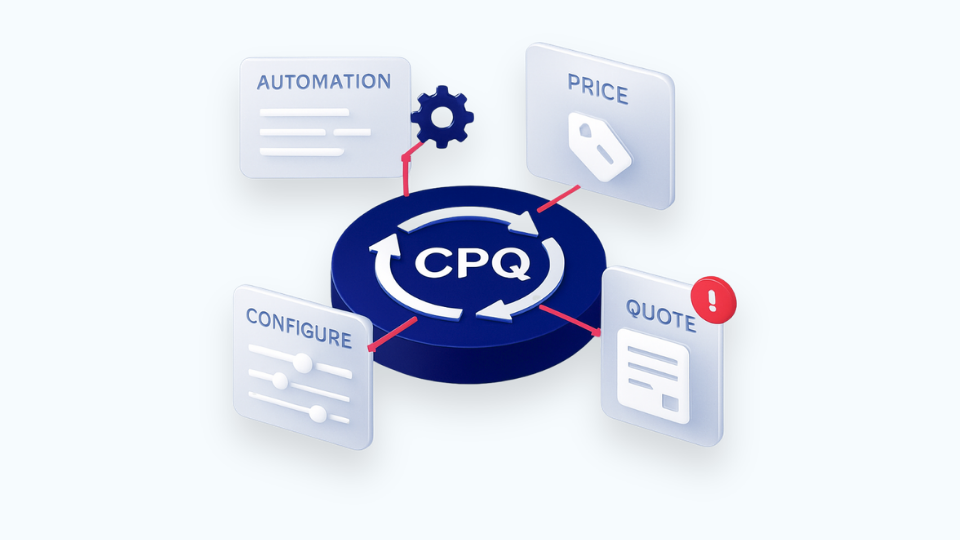
Salesforce CPQ went End-of-Sale in March 2025. For most companies we talk with, it reads like an IT ticket. Swap one quoting tool for another. Move on.
Six months into migration, they see it differently. This is not a CPQ replacement. It is a rebuild of your revenue operations architecture. And a rebuild is the moment to ask a bigger question than "what replaces CPQ?"
The bigger question: which CPQ architecture fits how your business sells?
We have guided European mid-market companies through 50+ CPQ migrations. The ones who come out ahead answer that question before they pick a tool. For some the answer is Revenue Cloud. For others it is a specialised CPQ on an independent CRM. The right path depends on your stack, not on ours.
ON THIS PAGE
This is not a tool swap
Your CPQ does not work alone. It connects your CRM to your ERP, your billing, your contract management, and your document generation. When CPQ sunsets, every one of those integration points breaks and needs rebuilding.
Revenue Cloud does not change that. It is a complete reimplementation, not an upgrade. Same timeline. Same disruption. Same user retraining as moving to any other platform.
So the real choice is not "rebuild or not." You rebuild either way. The choice is what you rebuild on.
What the sunset asks you to decide
You have two paths.
Path 1: Consolidate deeper into Salesforce. Migrate to Revenue Cloud Advanced. Rebuild your CPQ logic, pricing rules, and workflows. Accept the licensing increase. Run quoting, billing, contracting, and revenue operations inside one vendor's ecosystem. For companies already deep in Salesforce, this simplifies the stack and unifies the revenue lifecycle.
Path 2: Rebuild on an independent architecture. Move to HubSpot or another CRM. Pair it with a specialised CPQ that connects to both your CRM and your existing ERP. Keep platform independence and renewal leverage.
Most companies weigh Path 1 and skip past Path 2 without examining it. They assume changing CRM is harder than changing CPQ. It rarely is, because you are already rebuilding CPQ in full. Revenue Cloud asks for the same configuration effort, the same timeline, and the same process redesign as any alternative. The difference is which architecture you end up running.
When each path fits
Revenue Cloud fits if:
- You use several Salesforce clouds, so consolidation simplifies your stack.
- You need Salesforce's native billing and revenue recognition.
- Your team prefers Salesforce, and a familiar platform outweighs the cost.
- Your strategy is committed to the Salesforce platform.
An independent architecture fits if:
- You use mainly Sales Cloud, and your other revenue operations run outside Salesforce anyway.
- Your SAP or ERP integrations matter more than native CRM-CPQ integration.
- You want each vendor's roadmap to affect one system, not your whole stack.
- Your sales team finds Salesforce heavy, and your CFO is questioning the cost trajectory.
The independent architecture in practice
Across our implementations, one pattern holds for companies that keep CRM and CPQ independent: more flexibility, and often a lower long-term cost.
The architecture looks like this. Your customer data lives in HubSpot. Your product data stays in your ERP, whether SAP, Microsoft Dynamics, or Oracle. Your specialised CPQ sits between them with native connectors to both. When one vendor changes its roadmap, the change affects one system, not your whole revenue stack. When a CPQ vendor raises prices, you switch CPQ without touching CRM or ERP.
Consider the pattern we see most in SAP environments. A mid-market manufacturer runs Salesforce CRM, Salesforce CPQ, and SAP ERP. They use Sales Cloud but not Service Cloud or Marketing Cloud. The sales team finds Salesforce heavy. Product data and pricing logic live in SAP. Salesforce has grown expensive for what they use.
CPQ goes End-of-Sale. Salesforce proposes Revenue Cloud: a higher licensing cost and a full rebuild. The CTO asks the question that shapes the project. "If we rebuild anyway, which architecture fits how we sell?"
The alternative on the table: HubSpot CRM with a specialised CPQ connected natively to SAP. Same rebuild effort. A different long-term architecture. This path tends to show three things. Adoption runs faster, because a simpler interface fits how reps work and lowers resistance. Lock-in risk drops, because one vendor's strategy change hits one system. Renewal leverage holds, because native connectors replace custom code and independence keeps competitive pressure on every contract.
The lesson is not "leave Salesforce." It is that a full rebuild is a rare chance to re-examine the whole architecture, while the cost of switching is already on the table. For a company deep in the Salesforce ecosystem, that same review points back to Revenue Cloud.
The question to ask before you decide
How much does roadmap control matter to you?
With deeper consolidation, one vendor's roadmap shapes your timing and your options. With independence, you set the pace of change yourself. Neither is wrong. The weight you give this depends on your strategy.
Then run the numbers. Calculate the five-year total cost of ownership for both paths. Include licensing, implementation, training, integration maintenance, and the cost of a future migration. Add the hidden costs: productivity loss during transition, integration rebuilds, process redesign, and parallel operation.
Independence often lands at a lower five-year cost. Consolidation often lands at a simpler operating model. Weigh both against your strategy, not on the cost line alone.
How we help
We start by mapping your real architecture. Where does your customer data live? Where does your product data live? How do your systems actually connect today?
Then we evaluate both paths honestly. Revenue Cloud with realistic costs and timelines. Independent alternatives with realistic costs and timelines. We show you both and let you decide. For SAP environments, we usually recommend DealHub. For document-heavy workflows, GetAccept.
Book a demo
You’ll walk away with:
- A high-level map of your data and system connections.
- Baseline estimates for migration risks, timelines, and costs.
- An objective evaluation of your best path forward.

